The mind beats the sword, again

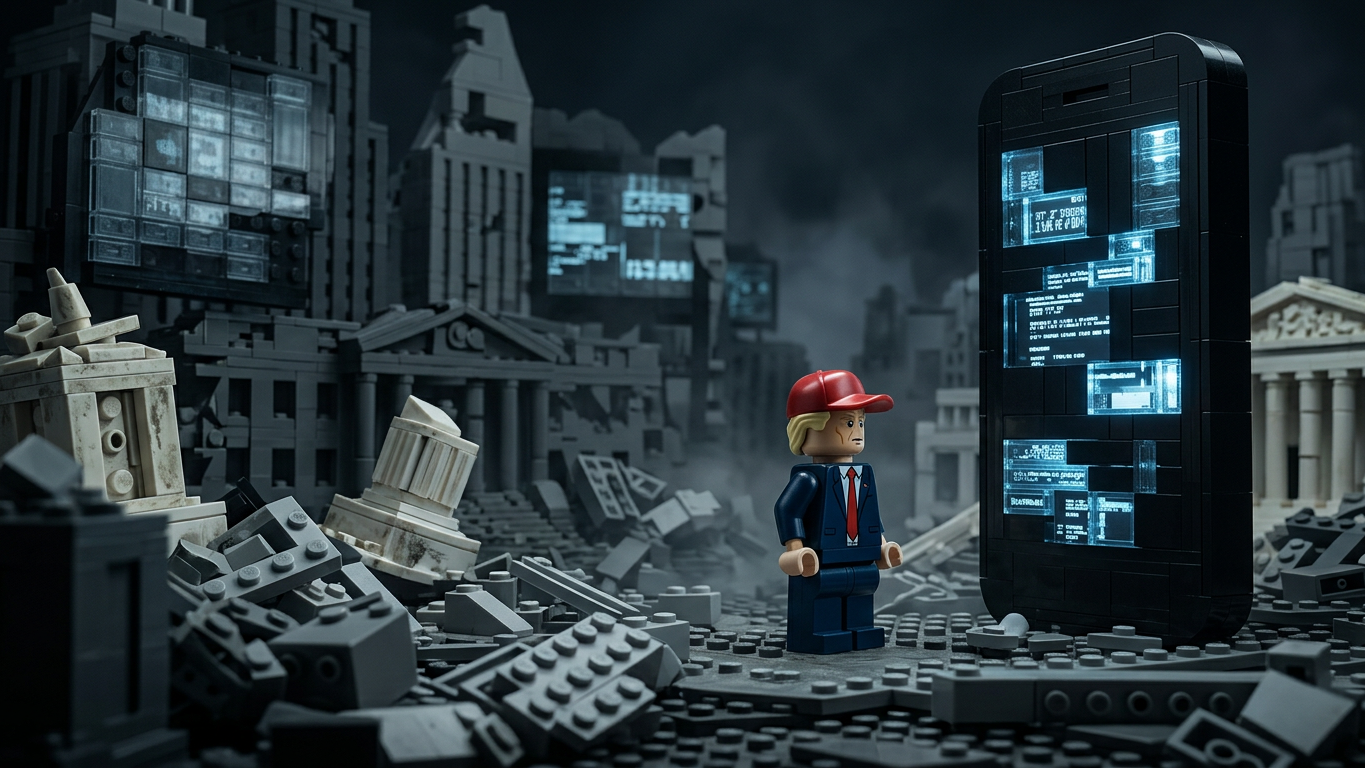
Iran's Lego videos are not propaganda in the classical sense. They do not ask you to admire Iran. They ask you to complete a thought you were already having about your own government. It is aikido: the force that takes you down is your own.

The mind beats the sword, again

Iran's LEGO videos and the grammar of cognitive warfare

How ten creators under twenty-five outpaced the communications apparatus of a superpower, and what that tells us about the architecture of influence in the algorithmic age.

Of course, I had to write about this. I have been watching the LEGO videos for weeks now. Not casually, but with the particular attention of someone who spent a year arguing, in a dissertation nobody outside a small academic committee was likely to read, that short-form algorithmic video had become the first communications environment purpose-built for cognitive warfare rather than merely adapted to it (Rifesser, 2023). And I should be honest: stripped of their origin and intent, the videos are impressive. The production is sharp. The music is good. The timing is precise. I caught myself watching one twice before the analyst in me registered what the viewer in me had already accepted. That reaction is not incidental. It is the mechanism. It is exactly what my thesis warned about, and it works on trained eyes too.

When Al Jazeera published Alia Chughtai's piece on 17 April, "'Vengeance for all': How Iran's LEGO videos won narrative war against Trump," it confirmed what anyone following the information layer of the US-Israel-Iran war already sensed. Iran is not winning the war. It cannot win the war. But it is winning the argument about what the war means, and it is doing so with a team of ten people between the ages of nineteen and twenty-five, using off-the-shelf AI animation tools and a deep, almost intuitive understanding of how the Western information environment actually works (Chughtai, 2026).

Napoleon observed that there are two powers in the world, the sword and the mind, and that in the long run the sword is always beaten by the mind (Kumar, 2022). That aphorism has survived because it names something durable about how conflicts end. What has changed is not the doctrine. What has changed is the medium through which hearts and minds are reached, and the speed at which a competent adversary can now reach them.

What the videos actually do

The central Explosive Media video, viewed approximately 150,000 times on X before YouTube removed the parent channel, is worth describing precisely because its construction reveals its function. Iranian soldiers in LEGO form stick banners on missiles. Each banner names a category of American violence: Hiroshima, Abu Ghraib, Iran Air Flight 655, Rachel Corrie, the children of Epstein Island. The missiles fire. Giant statues of Trump and Netanyahu collapse. The caption reads: "One vengeance for all." The aesthetic is childlike. The emotional register is not (Chughtai, 2026).

Other videos in the series use rap beats and trap music to mock Trump, often deploying his own rhetoric against him. The word "LOSER," Trump's signature insult, is turned back on him. MAGA caps appear not as tribal identity markers but as indictments. The Epstein files, the accusation that Trump serves Israeli rather than American interests, the betrayal of working-class promises: none of these are Iranian talking points. They are American ones, redirected. The spokesperson for Explosive Media told Al Jazeera the team is independent, with Iranian state media among their customers rather than their controllers (Chughtai, 2026). Whether that distinction is operationally meaningful is a separate question. What matters analytically is that the operation does not require the sender to be trusted, or even known, to succeed.

This is not propaganda in the classical sense. Propaganda tries to persuade you of a proposition. What the LEGO videos do is something closer to what NATO's Allied Command Transformation has been calling cognitive warfare since roughly 2020: the shaping of the conditions under which propositions are formed in the first place (Bernal et al., 2020; Claverie and du Cluzel, 2022). The videos do not ask you to admire Iran. They ask you to complete a thought you were already having about your own government. The sender disappears. The sender disappears. Like in Aikido: the force that takes you down is your own.

The trust vector

There is a reason these videos travel faster and land harder than conventional state messaging, and it is not production quality. It is the medium itself. LEGO is a trust object. It is what parents hand to children. No cognitive filter in any viewer's repertoire tags a brick animation as hostile state communications. The threat detection heuristic engages late, if at all. By the time a viewer recognises the content as adversarial, the emotional payload has already been delivered, the frame has already been installed.

This is the mechanism I tried to describe in my 2023 thesis through the lens of neuropsychology. The minor brain processes emotional visual content predominantly through the amygdala until roughly the age of twenty-five, while the prefrontal cortex, responsible for critical evaluation, is still maturing (Abrams, 2022; American Academy of Child and Adolescent Psychiatry, 2017). Mirror neurons, as Molnar-Szakacs and Overy (2006) demonstrated, mean that observed action and music trigger imitation and emotional synchronisation. The LEGO videos are engineered for exactly this neurology. The pacing is rap and trap. The visual density is extreme: on the McQuivey calculation I used in the thesis, a fifteen-second video at thirty frames per second carries a persuasive payload equivalent to roughly 450,000 words (Rifesser, 2023). The content is designed for the brain the viewer actually has, not the brain the State Department wishes the viewer had.

What I did not predict in 2023 was that a state actor outside China would adopt this template so completely, and so cheaply. The barrier to entry I identified has fallen further than I estimated. Mapped against the interdisciplinary framework of that thesis, the LEGO campaign activates at least nine distinct mechanisms simultaneously, and it is their convergence, not any single one in isolation, that makes the operation effective.

  • Trust vector disguise. Lego is a childhood object that bypasses the adult threat detection filters that would otherwise tag hostile state messaging on sight.
  • Aikido (or jiujitsu) framing. The videos do not ask the Western viewer to believe Iran; they ask the viewer to complete a thought they were already having about Epstein, MAGA betrayal, and Israel's first policy. The sender disappears.
  • Grievance bundling. Hiroshima, Abu Ghraib, Iran Air 655, Rachel Corrie, and Epstein are installed as one moral category, so every future US action is pre-interpreted through the frame.
  • Amygdala first design. Rap beats, rapid cuts, and a fifteen-second runtime are calibrated for the emotional brain of viewers under twenty-five, whose prefrontal cortex is still maturing.
  • Mirror neuron activation. Music and observed action trigger imitation and emotional synchronisation, which is why the content is shared, remixed, and localised rather than merely watched.
  • Algorithmic fit. Short, visually dense, emotionally arousing video is what every major feed now rewards, so the platform itself amplifies the operation without Tehran paying for distribution.
  • Attribution decay. Once the videos are mirrored and remixed, the question of who made them becomes operationally meaningless, which is the classic signature of a Fifth Generation Warfare operation.
  • Asymmetric production economics. Ten creators under twenty-five, with off-the-shelf animation tools, out-produce the combined communications apparatus of a superpower at near-zero marginal cost.
  • Censorship Aikido (or jiujitsu). When YouTube removed Explosive Media, the removal itself became a secondary propaganda beat confirming the "West silences truth" frame. The platform response fed the operation.
  • Register match. Mockery and smack talk are the native dialect of the feed. Iran is speaking the language of the medium rewards, while US counter-messaging is still speaking the language of the press conference.

Sharp power without the platform

My thesis argued that TikTok functioned as a Chinese Trojan Horse, operationalising the People's Liberation Army's Three Warfare doctrine of psychological warfare, public opinion warfare, and legal warfare within a Fifth Generation Warfare grey zone (Rifesser, 2023; deLisle, 2020). The argument leaned on Walker's (2018) concept of sharp power: the deceptive use of information for hostile purposes, piercing, penetrating, and perforating the open information environments of democracies while shielding the sender's domestic space from reciprocal influence.

Iran's LEGO campaign executes Walker's framework with near-textbook precision, but with a structural innovation my thesis did not anticipate. Tehran does not own the platform. The videos live on X, on YouTube before removal, on Instagram reshares, and on mirror accounts across platforms owned by Western corporations. China built the architecture; TikTok, an algorithmic short video, integrates entertainment and influence. Iran has borrowed the architecture without needing to own the infrastructure. The Three Warfare logic, manipulation of foreign media narratives, erosion of the opponent's decision-making will, framing of the adversary's actions as illegitimate, transfers cleanly across platforms because the algorithmic grammar is now universal. The feed logic TikTok pioneered has colonised the wider internet.

This matters for the original policy prescription. In 2023, I argued for an emergency ban on TikTok. The Iran case suggests that banning a single platform addresses a symptom, not the underlying condition. The condition is that every major Western-owned platform now optimises for the same short-video logic: retention, emotional arousal, and network effect. The architecture is embedded. And it is structurally indifferent to the difference between entertainment and influence operations.

The asymmetry of narrative competence

What makes the Iranian campaign so striking is not its sophistication in isolation but the contrast with the American counteroffer. The White House has been running its own social media war effort since strikes began on 28 February. It has spliced real missile-strike footage with clips from Call of Duty, Grand Theft Auto, Top Gun, Gladiator, and SpongeBob SquarePants (PBS, 2026; France 24, 2026). Communications director Steven Cheung posted the Grand Theft Auto cheat code for unlimited ammunition alongside bombing footage. Actor Ben Stiller publicly demanded that the White House remove a clip from Tropic Thunder, writing that war is not a movie (NBC News, 2026).

Professor Marc Owen Jones of Northwestern University in Qatar, who has been tracking the information dynamics of this conflict closely, put the contrast plainly in the Al Jazeera piece. Iran's LEGO videos are well thought out, detailed, and narratively coherent. American propaganda, by comparison, amounts to explosions with Hollywood films cut through them (Chughtai, 2026). Roger Stahl, a University of Georgia communications professor specialising in propaganda and war, noted in PBS reporting that the White House videos contain no human beings, no schoolchildren, no suggestion that people suffer on the other end (PBS, 2026). They are hard-power aesthetics in a soft-power moment. They are the wrong weapon.

The Iranian campaign, by contrast, opens with the Minab girls' school. It names the dead. It names the historical dead across seven decades. It constructs a grievance ledger that bundles Hiroshima, Abu Ghraib, Iran Air 655, Rachel Corrie, and the Epstein files into a single moral category. Once that bundle is installed as a coherent frame, every subsequent American action for the duration of the war is pre-interpreted through it. This is what Abbott (2010) described as the manipulation of the observational context in order to make the enemy do one's will, the signature of Fifth Generation Warfare, operationalised at the speed of the feed (Krishnan, 2022).

The uncomfortable fact is that a PBS/NPR/Marist poll found that 56 per cent of Americans oppose military action in Iran (PBS, 2026). The White House is running memes to sell an unpopular war. Iran is running memes to make sure it stays that way. One of these operations is working.

The diffusion problem

The LEGO template has already migrated beyond Iran. Pakistani creators, including Nukta Media, produced their own versions ahead of the US-Iran negotiations in Islamabad on 11 April. This is the tell. The content is not staying inside a single national information ecosystem. It is optimised for the Global South viewer who already distrusts Western framing, and the algorithm does the sorting on Tehran's behalf. Iran does not need to know that a Pakistani creator will remix the content, or that a user in Johannesburg will screenshot a frame for an Instagram story, or that a progressive audience in the United States will find the Epstein framing irresistible. The system finds those audiences automatically.

This is the structural inversion my thesis tried to name. In twentieth-century information warfare, the sender chose the audience. In the algorithmic environment, the audience chooses the sender, and the sender's job is only to produce content the sorting function will reward. Iran has understood this. The videos are engineered for the sort, not for a specific viewer.

Rob Joyce, the NSA's senior cybersecurity adviser, once offered a metaphor I cited in the thesis: Russia is a hurricane, China is climate change (Marks, 2019). The Iran case suggests a third entry. Iran is wildfire: episodic, regional in origin, globalised by the wind of algorithmic distribution. And like wildfire, it exploits conditions it did not create.

What the platform removal revealed

YouTube removed the Explosive Media channel. X did not. The asymmetry is not a policy detail. It is a geopolitical fact. Every platform moderation decision in this war is a foreign policy decision, taken by private actors under commercial incentives that do not align with any state's strategic interest.

More consequentially, the removal itself became a secondary narrative. Explosive Media posted: "Are our LEGO-style animations actually violent?" Iran's Foreign Ministry spokesman Esmaeil Baghaei called the takedown a move to suppress the truth about an illegal war (Al Jazeera, 2026). The censorship response fed the original operation. The content persisted on X, mirrors multiplied, and the story shifted from "Iran makes propaganda" to "the West silences every voice that speaks the truth." This is a pattern any analyst of information operations should recognise. Platform enforcement, when applied selectively and visibly, becomes the adversary's best recruitment asset.

Frame installation, not persuasion

The mistake most commentary makes about the LEGO videos is to ask whether they change minds. That is the wrong question. The right question is whether they install a frame. The distinction matters.

Persuasion is transactional. It moves a viewer from position A to position B on a specific proposition. Frame installation is architectural. It changes the interpretive lens through which all subsequent propositions are evaluated. The LEGO videos are not arguing that Iran is right. They are installing a bundle, American violence across seven decades, Epstein, betrayal of MAGA promises, subordination to Israeli interests, as the default interpretive context for everything the United States does in this war and after it.

The New Yorker called the videos "inescapable artifacts" of the war (cited in Wikipedia, 2026). That phrasing is more precise than it perhaps intended. An artifact is something that remains after the event that produced it has ended. The kinetic exchange will end. The frame the LEGO videos installed will outlast it. The next American administration, the next Israeli operation, the next regional crisis will be read through the interpretive architecture Tehran built in the spring of 2026 with bricks, rap beats, and the Epstein files.

I ended my 2023 thesis with a line from Shtepa, cited via Orinx and Struye de Swielande (2022): "While manpower and infrastructure can be restored, the evolution of consciousness cannot be reversed, especially since the consequences of this mental war do not appear immediately but only after at least a generation, when it will be impossible to fix something." I wrote it thinking about China and a Western generation growing up on TikTok. The Iran case suggests the horizon is shorter than I estimated. The consciousness being shaped by the LEGO videos is not a generation from now. It is this quarter's global audience of a war that most Americans already oppose.

The sword is still being beaten by the mind. The bricks are only the latest skin. And the doctrine, whatever Napoleon did or did not say, has not changed. Only the battlefield has, and we are standing on it.


Bibliography

Abbott, D.H. (2010) The handbook of fifth-generation (5GW): a fifth generation of war. Ann Arbor, MI: Nimble Books.

Abrams, Z. (2022) 'Why young brains are especially vulnerable to social media', American Psychological Association, 25 August.

American Academy of Child and Adolescent Psychiatry (2017) 'Teen Brain: Behavior, Problem Solving, and Decision Making'.

Bernal, A., Carter, C., Singh, I., Cao, K. and Madreperla, O. (2020) Cognitive Warfare: An Attack on Truth and Thought. NATO Innovation Hub.

Chughtai, A. (2026) "'Vengeance for all': How Iran's Lego videos won narrative war against Trump", Al Jazeera, 17 April.

Claverie, B. and du Cluzel, F. (2022) 'The Cognitive Warfare Concept', NATO Innovation Hub.

deLisle, J. (2020) 'Foreign Policy through Other Means: Hard Power, Soft Power, and China's Turn to Political Warfare to Influence the United States', Orbis, 64(2), pp. 174-206.

France 24 (2026) 'White House releases video montages gamifying Iran war on social media', 7 March.

Krishnan, A. (2022) 'Fifth Generation Warfare, Hybrid Warfare, and Gray Zone Conflict: A Comparison', Journal of Strategic Security, 15(4), pp. 14-31.

Kumar, A. (2022) 'Psychological Warfare (PSYOPS) - The Pandora's Box of Security Issues', Modern Diplomacy, 14 November.

Marks, J. (2019) 'Analysis: The real cybersecurity battleground', Press Herald, 10 March.

Molnar-Szakacs, I. and Overy, K. (2006) 'Music and mirror neurons: from motion to "e" motion', Social Cognitive and Affective Neuroscience, 1(3), pp. 235-241.

NBC News (2026) 'The White House compares deadly conflict to video games and movies in memeified videos to win support for Iran war', 13 April.

Orinx, K. and Struye de Swielande, T. (2022) 'China and Cognitive Warfare: Why Is the West Losing?', NATO Collaboration Support.

PBS NewsHour (2026) 'White House's use of internet memes to promote Iran war sparks criticism', March.

Rifesser, B.J.F. (2023) An Interdisciplinary Analysis of the Weaponization of TikTok. MSc dissertation. Liverpool John Moores University.

Walker, C. (2018) 'What Is "Sharp Power"?', Journal of Democracy, 29(3), pp. 9-23.