The payload is doubt
More than two dozen European flights threatened in one week, no explosive found. Alongside, claimed sabotage of supermarket fridges. The attackers spend minutes, the defenders spend fuel, airspace and public trust. The payload is not panic. It is doubt in the systems ordinary life depends on.

Europe’s week of bomb hoaxes and claimed cold-chain sabotage cost its authors almost nothing. What it buys them is not panic but a slow erosion of trust in ordinary systems.
Over recent months I have written a series of pieces on this platform about cognitive warfare, perception management and the way threats move between domains before they become physical (Rifesser, 2026c). This week, on LinkedIn, I shared some thoughts on NATO’s Chief Scientist Research Report on Cognitive Warfare, which describes the goal of cognitive warfare as “exploiting facets of cognition to disrupt, undermine, influence, or modify human decision-making” (NATO Science & Technology Organization, 2025, p. 12). My point there was simple. Sometimes delaying or paralysing a decision is the objective itself, and an adversary does not always need to create the distraction when the system will generate it on its own.
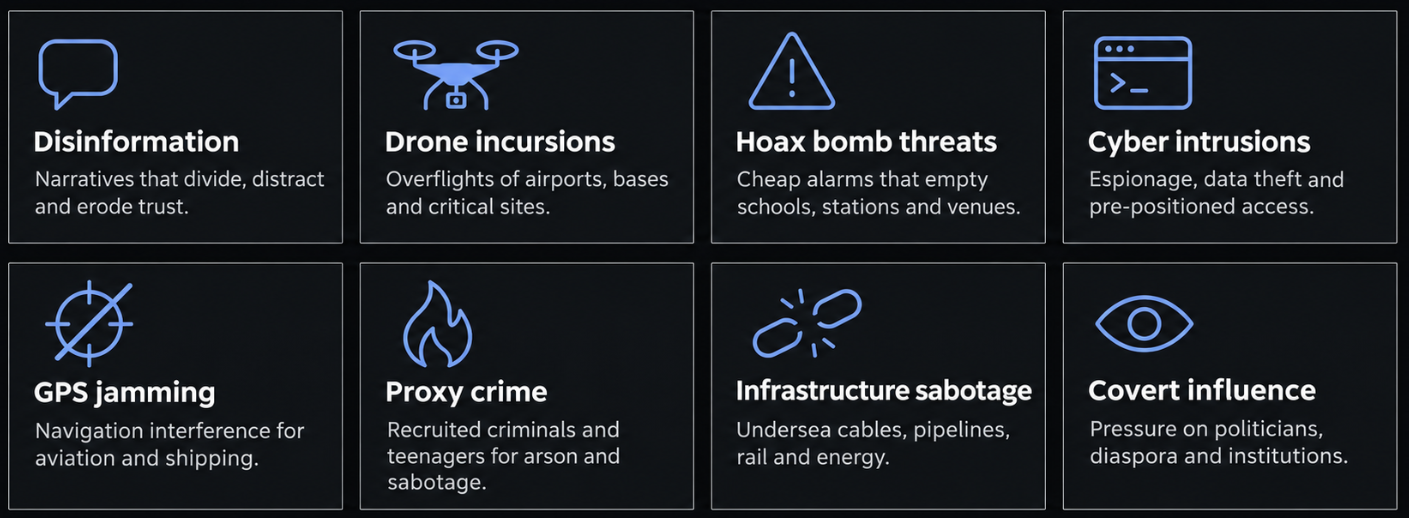
Europe spent the same week supplying a live demonstration.
Since Monday, passenger flights across Europe have received bomb threats in waves. A Wizz Air flight from Luton to Sofia diverted to Budapest under Hungarian fighter escort. On Tuesday, around ten flights were targeted, a Warsaw airport briefly closed, and Italian jets escorted a Ryanair aircraft into Rome (Oh, 2026; Euronews, 2026). On Thursday, an Aer Lingus flight from Dublin to Rome was escorted to the French air force base at Évreux, and a Wizz Air flight bound for Warsaw diverted to Vienna. A London to Sofia service ended up in Plovdiv, and Spain’s Guardia Civil received three emailed threats in under twenty minutes (Euronews, 2026; Henrys, 2026). In parallel, an email claiming to come from Iran’s Revolutionary Guard reached 271 Italian schools and forced evacuations (Oh, 2026). By Thursday more than two dozen flights had been named. No explosive has been found.
It is tempting to file these as hoaxes and move on. That misreads the mechanism.
A hoax threat works because the system cannot afford to ignore it. Every email triggers the full protocol: diversion, evacuation, search, military escort. The sender spends minutes. The defender spends fuel, airspace, police capacity and public confidence. The bomb was never the point. The response is the delivery mechanism, and what it delivers is doubt.
There is an uncomfortable inversion here. The attacker writes an email; the defender produces the imagery. Fighter jets alongside an airliner, passengers filing off at a military airfield in Normandy, around 1,800 pupils and staff walked out of a Rome school complex (Oh, 2026). Each of these is a correct protective decision. Each is also footage that circulates far beyond the people involved, and it reaches people who will never board those flights. In Stories That Kill, Stories That Protect I argued that the story often does its work before anything physical happens (Rifesser, 2026d). A hoax is that principle reduced to its purest form: a story with no physical act behind it at all. The aim is not panic, which burns out quickly and tends to provoke resolve. It is something quieter: the sense that ordinary movement now carries a small, unknowable tax of disruption, and that the institutions responsible for it can be made to dance by anyone with an email account. That is a cognitive effect, not a kinetic one, and the defender’s own visibility is what carries it.
In the pathway model I set out in Inside the Hybrid Zone, exposure usually moves from signal to story to behaviour to proximity before it becomes an incident (Rifesser, 2026b). A bomb hoax collapses that chain. The story alone produces the behaviour, and the sender never needs to get near an aircraft. That is what makes it so efficient. It requires no capability, only a credible-sounding sentence and a flight number, which any public tracking site provides.
The attribution picture is equally instructive, chiefly because so little of it is established. The school emails claimed an IRGC identity but reportedly came from a spoofed Egyptian ministry address. Italian authorities have neither verified the claimed identity nor linked the emails to the aviation alerts (Oh, 2026). On Thursday, emails sent to three Italian airports, as shared by Italian media, allegedly came from “fighters of the Male State” and named two Rome-bound flights. The Male State is a Russian far-right misogynist movement that Russian authorities themselves designated extremist in 2021 (Henrys, 2026). That claim, too, is unverified. No state has formally attributed any part of the wave (Henrys, 2026). My interpretation, and it is only that, is this. A Russian movement outlawed in Russia is close to an ideal banner, because it carries a Russian signature while offering Moscow a ready denial. Whether this is one actor wearing several labels, several actors exploiting one moment, or opportunists copying the news, the effect is the same. Investigators chase identities while the pattern does its work. Ambiguity is not a gap in the operation. It is part of its design. Three contradictory banners in one week also echo what RAND called the “firehose of falsehood”: high volume, multiple channels and no commitment to consistency (Paul and Matthews, 2016), a model I discussed in Beyond the Firehose (Rifesser, 2026a). The contradictions are not a weakness of the message. They are part of how it works.
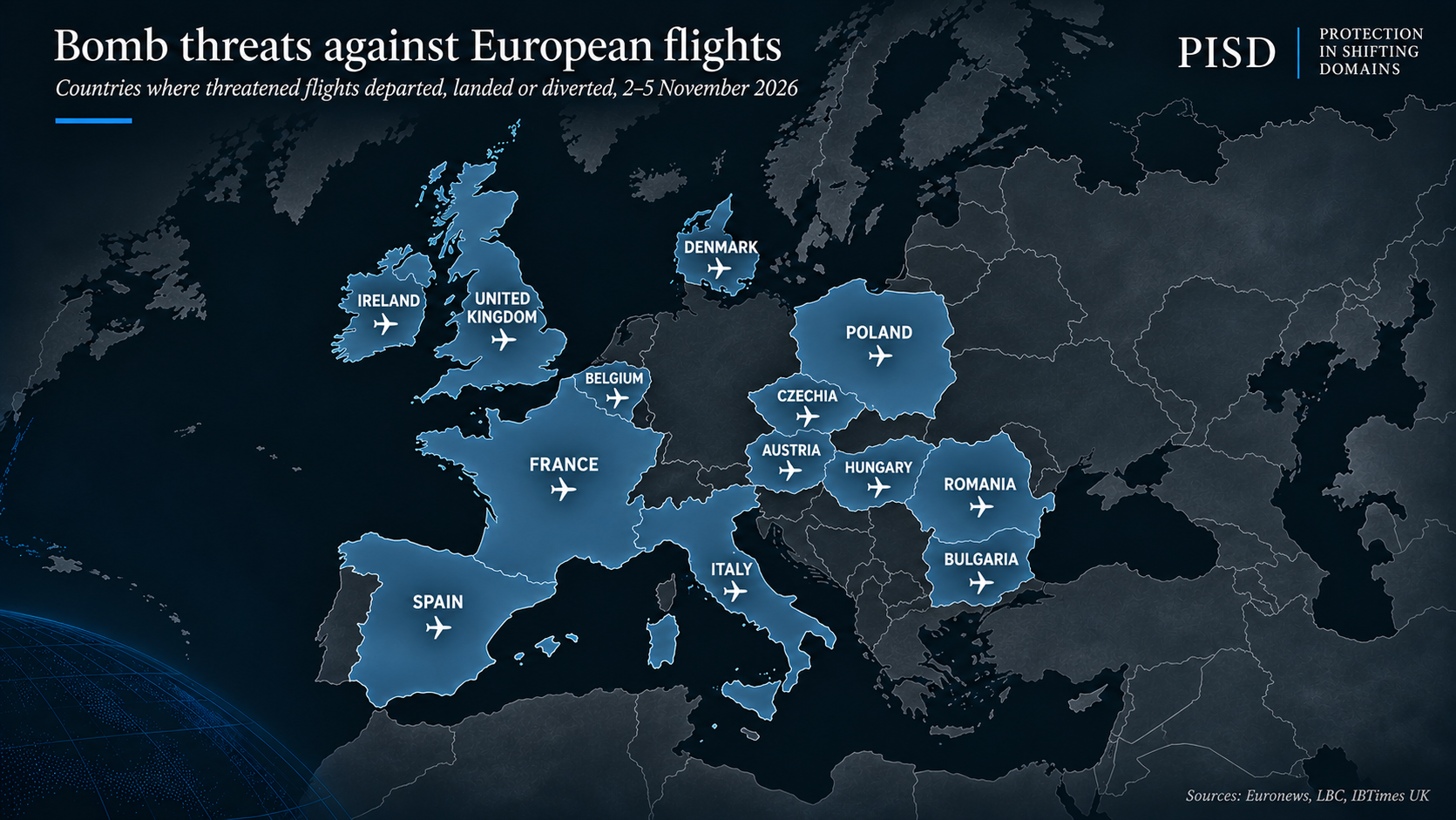
The context makes the question unavoidable. Germany has blamed Russia for an attack on Leipzig airport in August. Denmark, Poland and Romania, all affected on Thursday, have previously accused Moscow of sabotage, which Russia denies (Henrys, 2026). NATO’s own report lists, among the features that distinguish cognitive warfare from conventional influence operations, that it is often designed to create chaos and complexity below the threshold of armed conflict, without necessarily knowing what behavioural change it will produce (NATO Science & Technology Organization, 2025, p. 10). A wave of anonymous threats under shifting banners fits that description closely. Whoever is behind this week, the pattern sits squarely in that category of pressure. It is cheap, deniable, below any threshold that justifies a state response, scalable by email, and aimed at what open societies depend on most: the assumption that ordinary movement is safe.
The flights were not the only front this week. In parallel, NoName057(16), a pro-Russian hacktivist collective, and a second group, Z-Pentest Alliance, claimed responsibility for tampering with supermarket refrigeration systems in several European countries. The claim has not been confirmed, and there is no public technical attribution linking these groups to the wave as a whole (Da Rold, 2026). What is reported is the damage. In Abruzzo, the controls of a supermarket’s fridges and freezers were set to 150 degrees overnight, and the units reached around 40 degrees before technicians intervened. At least four Coop stores in Sicily reported similar problems. The Italian government describes the domestic impact as very limited (Da Rold, 2026). NoName is better known for crude denial-of-service attacks, and it survived a Europol-led takedown operation in July 2025 (Al Jazeera, 2025). The telling detail is in the claim itself: the groups say they used no malware, only functions already built into the controllers (Da Rold, 2026). Nothing links the refrigeration incidents to the flight threats, and the two should not be merged without evidence. But they share a logic. One turned the aviation security protocol into the weapon, the other turned the refrigeration controller into one. Neither needed a bomb or an exploit, only access to a system that does exactly what it was designed to do. In the terms of the four-lane framework from Protection in the Hybrid Zone, one campaign travels from the narrative lane into the physical, the other from the digital lane into the physical, and neither requires anyone to cross a border (Rifesser, 2026c).
The refrigeration claim also works on the same register as the hoaxes. A freezer reaching 40 degrees in an Abruzzo supermarket is a commercial loss. A headline saying pro-Russian hackers can reach the fridges is a question every shopper now carries into the store. Whether the claim proves true matters less to that effect than one might hope. The aviation security analyst Eric Schouten argued that railways, supermarkets and blood banks belong in the same frame as aviation when thinking about hybrid pressure (Henrys, 2026). This week, two of those fronts were active at once.
The background noise nobody hears
The hoaxes and the fridges are this week’s story. Underneath them runs a third front that has stopped making headlines because it never stops. Along NATO’s eastern flank, satellite navigation is now routinely jammed and spoofed. Data compiled for the Council of the European Union shows how fast this has grown. The number of aircraft affected in Polish airspace rose from 1,908 in October 2024 to 2,732 in January 2025. Latvia went from 790 to 1,288 over the same months, and Lithuania from 556 in March 2024 to 1,185 in January 2025 (Council of the European Union, 2025). The trend has not reversed. Poland’s National Institute of Telecommunications reported significant disruption on about 70 per cent of days in May and June 2026, and full-scale disruption on 63 per cent of days in the first weeks of August. It traced the source to electronic warfare activity in the Baltic Sea region (Galka Reczko, 2026). On 21 August, the Polish minehunter ORP Albatros was jammed in the Baltic, an incident NATO’s Joint Force Command Brunssum confirmed (Galka Reczko, 2026).
Unlike the hoaxes, this front is attributed. In October 2025, the ICAO Assembly reviewed evidence from Estonia, Finland, Latvia, Lithuania, Poland and Sweden. It concluded that the interference originates from Russian territory and violates the Chicago Convention. The ICAO Council had already given Moscow thirty days to stop. Russia did not respond, and the interference continued (Civil Aviation Agency of Latvia, 2025; ICAO, 2025). Lithuanian authorities report that spoofing antennas in the Kaliningrad region grew from a few at the start of 2025 to several dozen, with a reach of up to 450 kilometres. That figure is a national claim, not an independent measurement (Galka Reczko, 2026).
That is the uncomfortable lesson for anyone who believes attribution solves the problem. Here the source is known, named and formally condemned by a UN body, and the jamming goes on. Attribution moved the issue from ambiguity into diplomacy. It did not move it into consequence. GPS jamming is the same logic as the hoax, stretched out over months. It costs the sender very little, it forces every pilot, ship’s officer and drone operator onto backup procedures, and it stays below any threshold that would justify a military answer. My interpretation, and it is only that, is that the value lies less in any single disruption than in normalisation. A cockpit warning that appears on every flight stops being an alarm and becomes weather. This is the same erosion of vigilance the hoaxes produce, achieved by a different route.
For protection teams, the practical consequences are concrete. Location data near the Baltic, in northern Poland and in the Baltic states cannot be treated as reliable. Phone positioning, tracking of a principal’s vehicle, drone overwatch and the time-stamps on incident logs can all be wrong without any visible sign. Spoofing is worse than jamming, because a false position looks exactly like a true one. Travel plans for the region need non-satellite fallbacks: offline maps, agreed check-in points and communications that do not depend on a single positioning source.
The deeper target may not be this week’s flights at all, but next month’s judgement. Insecurity has two faces, and the sender profits from both. The public learns to doubt that ordinary movement is safe. Crews, controllers and security staff learn to doubt the next alarm. The first erodes confidence; the second erodes vigilance. That leaves defenders with an unattractive choice. Keep paying full price, or start triaging threats and accept some residual risk. The Czech response on Thursday shows triage is possible: police assessed the threats as low credibility and the aircraft landed as scheduled (Henrys, 2026). But triage is a risk decision, and that is where the real weakness sits. The airline operations centre, the air navigation provider, the air force, the police and the ministry each act correctly within their own lane. Nobody owns the cumulative cost, and nobody is clearly authorised to decide when a threat no longer earns a full response. The same is true of a cold chain run by a franchisee, a maintenance contractor and a device manufacturer, each of whom can reasonably assume someone else secured the remote interface. That is the gap between the lanes in its purest form (Rifesser, 2026b).
For protection teams, the practical lesson is mundane and urgent. A diversion puts a client somewhere that was never on the plan: a military airfield in Normandy, Plovdiv instead of Sofia, Vienna instead of Warsaw. Travel support needs diversion contingencies for ground transport, accommodation and communications. It also needs a narrative plan, because a client’s family and board will read “bomb threat on flight” long before the aircraft is cleared. And since the threats name flight numbers, a client’s published itinerary is part of the exposure. For organisations, the refrigeration incidents are a reminder to audit what is reachable from the internet before someone else does. Early findings in Italy point to old equipment, interfaces exposed directly online and weak authentication (Da Rold, 2026). That is not an IT footnote when the device holds food, medicine or blood.
Not everything here is strategy. Email hoax waves have happened before without any state behind them. In October 2023, more than seventy threats hit French airports, almost all from the same email address (The Connexion, 2023). Copycats follow headlines, and hacktivist claims are often inflated. The cognitive effect argued here is also an interpretation: this week’s evidence shows disruption, not measured public fear. The argument doesn’t depend on attribution, however. The cost lands on the defender either way.
The question is not only who sent the emails or who reset the fridges. It is how much doubt Europe can absorb before ordinary life starts to price it in, in moving and in eating, and who has the authority to decide what a proportionate response looks like before the next wave. Disrupting a decision does not require changing it. Delaying it, multiplying it and making it expensive is enough. A society that responds to every hoax at full volume spreads the insecurity for the sender. A society that responds to none hands them the next real attack. The work lies in between, and it has to be agreed before the email arrives.
References
Al Jazeera (2025) ‘Joint global operation takes down pro-Russian hacking group’, Al Jazeera, 16 July. Available at: https://www.aljazeera.com/news/2025/7/16/joint-global-operation-takes-down-pro-russian-hacking-group
Civil Aviation Agency of Latvia (2025) ‘ICAO Assembly: Russia violated Chicago Convention and is endangering civil aviation’, Civil Aviation Agency of the Republic of Latvia. Available at: https://www.caa.gov.lv/en/article/icao-assembly-russia-violated-chicago-convention-and-endangering-civil-aviation
Council of the European Union (2025) Global Navigation Satellite Systems (GNSS) jamming and spoofing threats: Information from Lithuania, Estonia, Finland, document ST 9188/25. Brussels: Council of the European Union. Available at: https://data.consilium.europa.eu/doc/document/ST-9188-2025-INIT/en/pdf
Da Rold, A. (2026) ‘Supermercati nel mirino degli hacker, cosa rivela la rivendicazione degli attacchi’, Quotidiano Nazionale, 4 November. Available at: https://www.quotidiano.net/cronaca/supermercati-hacker-hb4jgac3
Euronews (2026) ‘Airbus plane from Dublin to Rome diverted to France airbase after bomb alert’, Euronews, 5 November. Available at: https://www.euronews.com/2026/11/05/airbus-plane-from-dublin-to-rome-diverted-to-france-after-bomb-alert
Galka Reczko, A. (2026) ‘Phones, drones and ships running blind as GPS malfunctions across Poland’, Euronews, 25 August. Available at: https://www.euronews.com/my-europe/2026/08/25/phones-drones-and-ships-running-blind-as-gps-malfunctions-across-poland
Henrys, R. (2026) ‘“Turn the skies red”: Radical right-wing Russian misogynistic hate group claims responsibility for flight bomb threats’, LBC, 5 November. Available at: https://www.lbc.co.uk/article/male-state-bomb-hoax-5Hjdkzh_2/
ICAO (2025) Russian Federation: Global Navigation Satellite System (GNSS) radio frequency interference (RFI), Assembly 42nd Session, Working Paper A42-WP/553. Montreal: International Civil Aviation Organization. Available at: https://www.icao.int/sites/default/files/Meetings/a42/Documents/WP/wp_553_en.pdf
NATO Science & Technology Organization (2025) Cognitive Warfare: NATO Chief Scientist Research Report. Brussels: NATO STO Office of the Chief Scientist. Available at: https://www.nato.int/content/dam/nato/webready/documents/sto/chief-scientist-report-cognitive-warfare.pdf
Oh, D. (2026) ‘Rome school evacuated after bomb threat as email claiming to be from Iran’s Guards targets 271 schools’, International Business Times UK, 4 November. Available at: https://www.ibtimes.co.uk/rome-school-evacuated-after-bomb-threat-email-claiming-irans-guards-targets-271-schools-1829999
Paul, C. and Matthews, M. (2016) The Russian ‘Firehose of Falsehood’ Propaganda Model: Why It Might Work and Options to Counter It. Santa Monica, CA: RAND Corporation.
Rifesser, B.J.F. (2026a) ‘Beyond the Firehose’, Protection in Shifting Domains.
Rifesser, B.J.F. (2026b) ‘Inside the Hybrid Zone: The Gap Between the Lanes’, Protection in Shifting Domains.
Rifesser, B.J.F. (2026c) ‘Protection in the Hybrid Zone’, Protection in Shifting Domains.
Rifesser, B.J.F. (2026d) ‘Stories That Kill, Stories That Protect’, Protection in Shifting Domains.
The Connexion (2023) ‘Ten French airports receive bomb alerts, five evacuated’, The Connexion. Available at: https://www.connexionfrance.com/news/ten-french-airports-receive-bomb-alerts-five-evacuated/208060