Two Wartime Videos, one Battlespace
Two wartime videos. Two propaganda languages. One polished and state-centered, the other mythic and identity-driven. Different aesthetics, same strategic aim: to shape perception, steer emotion, and compete over meaning long before facts are weighed in depth.

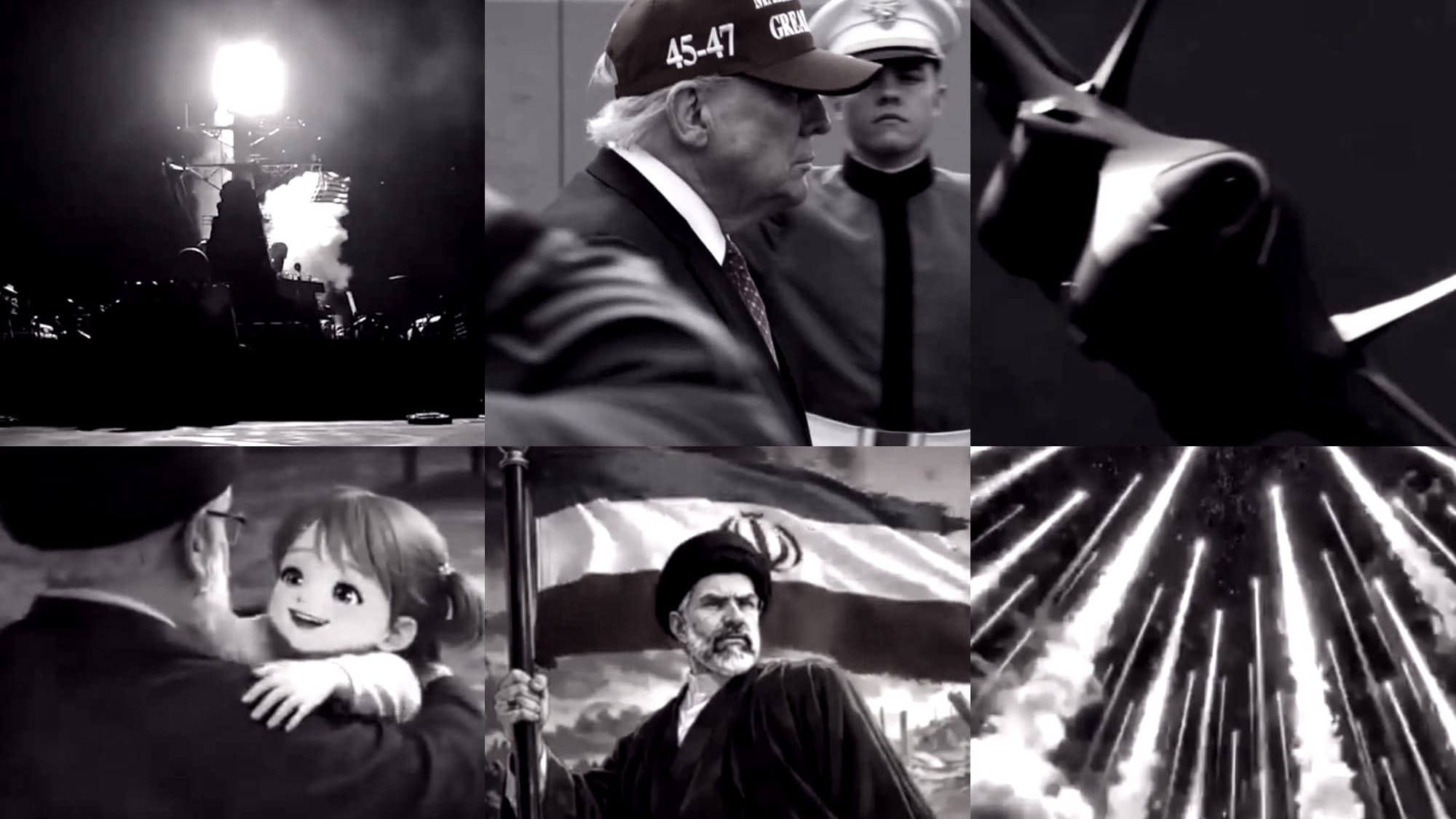
Sometimes a comparison presents itself without warning.
Two wartime videos appeared in my feed almost back to back. One, circulated through White House channels, adopted a polished, Top Gun-like aesthetic: speed, control, high production value, and cinematic confidence. The other, linked to Khamenei and shared through a BRICS-related channel, leaned into anime-style visual language: stylised struggle, moral intensity, and emotionally charged symbolism. On the surface, they seemed to belong to different political universes. On closer inspection, they looked like two different propaganda languages operating inside the same wider battlespace.
They were not simply media products released during wartime. They were wartime propaganda videos, designed to shape perception before slower judgment begins.
Information warfare and its modern form
That matters because modern political warfare is not limited to military force. RAND describes it as the intentional use of diplomatic, informational, military, intelligence, cyber, and economic means to affect political composition or decision-making, and notes that it is increasingly waged in the information arena, where success can be determined by perception rather than outright victory (RAND Corporation, 2019). Once seen through that lens, these videos become more than content. They become attempts to structure interpretation, emotion, and legitimacy in real time.
Both can be understood as wartime propaganda, not because everything in them must be false, but because both compress conflict into emotionally legible form. Propaganda does not always depend on fabrication. It often works by simplifying, selecting, stylising, and repeating until one interpretation feels intuitive and morally obvious (Walker and Ludwig, 2017). In wartime, that matters even more, because conflict has to be narrated before it can be socially processed and politically sustained.
Two aesthetic registers, one strategic function
The White House-style clip works through spectacle, legitimacy, and institutional confidence. Its visual grammar is cinematic, state-centred, and technologically assured. It frames force as precise, disciplined, and morally controlled. The message is not simply that power exists, but that power remains ordered, capable, and justified. It reassures the viewer that the state is still in command, still competent, and still entitled to act. That is what this aesthetic does so effectively: it packages military action as clarity, precision, and control.
The Khamenei-linked clip works through a different symbolic register. Its anime-style visual language is not incidental decoration. It translates conflict into a stylised moral universe of heroes, enemies, sacrifice, destiny, and resistance. As Naganuma (2021) argues, narrative should not be understood as a neutral stream of information, but as a vector that moves through the virtual domain into the cognitive domain, where it shapes psychology and behaviour. He also stresses that narratives gain force when they draw on emotional triggers such as victimhood, nostalgia, and collective identity. That is exactly why this type of video matters. It does not ask the viewer merely to understand a position. It asks the viewer to belong to a struggle.
Form, in both cases, is inseparable from function. Narratives are not only words, they include images, illustrations, music, symbols, pacing, and visual cues (Naganuma, 2021). The persuasive force of both clips lies not only in what they say, but in how they make the audience feel before reflection has fully begun.
Aristotle's rhetorical framework offers a useful lens here. In the Rhetoric, he identified three modes of persuasion: logos, the appeal to reason and logic; ethos, the appeal to the credibility and moral character of the speaker; and pathos, the appeal to the emotions of the audience (Aristotle, trans. Roberts, 1954). What makes both videos analytically interesting is how they distribute these appeals. The White House clip relies heavily on ethos, the visual grammar of state power, institutional competence, and technological precision signals that the speaker is authoritative and trustworthy. The Khamenei-linked clip inverts this emphasis, leaning almost entirely on pathos, sacrifice, destiny, and collective identity are not arguments, they are emotional states designed to be inhabited. In both cases, logos is subordinated. The viewer is not asked to reason toward a conclusion. They are asked to feel their way there. That is the defining feature of wartime propaganda across centuries: it does not eliminate rational appeal entirely, but it ensures that emotion arrives first.
Influence without fabrication
This connects directly to earlier work on disinformation, where I argued that influence does not always depend on outright falsehood (Rifesser, 2023). Often it works through framing, timing, emotional priming, selective emphasis, and the careful reduction of complexity. That same logic is visible here. These wartime propaganda videos do not need to fabricate everything in order to be effective. They shape interpretation by guiding attention, assigning meaning, and pre-structuring how audiences are likely to feel before they begin to evaluate facts in depth.
This argument also runs through earlier work on TikTok and cognitive warfare, where manipulation increasingly targets attitudes, perception, and behaviour through emotionally optimised media environments (Rifesser, 2023). The object of attack is not only the message environment, but the human interpretive process itself.
Cognitive warfare as the wider frame
The distinction between information warfare and cognitive warfare is important here. Information warfare is about controlling information flows. Cognitive warfare goes a step further by targeting how people react to information. It aims at influence and destabilisation by shaping public perception, public opinion, and eventually behaviour (Bernal et al., 2020). In that sense, what is under attack is not just the information environment it is the capacity for independent interpretation.
The comparison between these two clips should not be flattened, however. Both are wartime propaganda, but they are not identical in logic. The White House clip leans more toward strategic communication, legitimacy-building, and reassurance through state competence. The Khamenei-linked clip leans more heavily toward identity-based mobilisation through myth, sacrifice, and moral struggle. The difference is not whether they are propaganda. The difference is what kind of propaganda language they use.
The distinction between soft power and sharp power helps on the margins, but only if used carefully. The sharp power literature is strongest when describing authoritarian influence that works through manipulation, distraction, and penetration of open information environments rather than genuine attraction (Walker and Ludwig, 2017). That makes it more directly applicable to the Khamenei-linked clip than to the White House one. Still, placing the two side by side shows how contemporary wartime messaging now moves along a spectrum, from strategic reassurance and legitimacy-building to emotional manipulation and ideological mobilisation.
Conflict as a competition over meaning
From a protection perspective, this matters. Conflict today does not begin only when violence starts. It also develops in the space where narratives harden identities, intensify emotion, narrow interpretation, and prepare audiences to see events in one preferred way (Krishnan, 2022). That is why these videos should not be treated as peripheral media artefacts. They are part of the wider battlespace.
Besides they almost came out back to back, what struck me most was not how different these two videos were, but how similar they were in function. Again, one speaks the language of dominance, precision, and control. The other speaks the language of sacrifice, martyrdom, belonging, and resistance. Different aesthetics, different political vocabularies, different emotional triggers, but the same strategic ambition: to shape perception before deliberation, and emotion before analysis. War today is fought not only over territory and capability, but also over perception, legitimacy, and meaning.
Open questions
This analysis raises several questions worth sitting with. Does the aesthetic language of a propaganda video, state-cinematic versus manga-symbolic, tell us something meaningful about the political culture that produces it, or does style ultimately converge toward the same function regardless of origin? At what point does strategic communication shade into cognitive warfare, and who gets to draw that line? If both open and authoritarian systems now use emotionally optimised media to shape perception, does the distinction between sharp power and soft power retain analytical value, or does it risk becoming a way of legitimising one side's manipulation while condemning the other's? And perhaps most practically: as audiences become more aware of these techniques, do they become more resistant to them, or does awareness simply drive the production of more sophisticated forms of the same thing?
References
Aristotle (trans. Roberts, W.R.) (1954) Rhetoric. New York: Modern Library.
Bernal, P. et al. (2020) Cognitive Warfare. NATO ACT Innovation Hub.
Krishnan, A. (2022) 'Fifth Generation Warfare, Hybrid Warfare, and Gray Zone Conflict: A Comparison', Journal of Strategic Security, 15(1).
Naganuma, K. (2021) Warfare in the Cognitive Domain: Narrative, Emotionality, and Temporality. NIDS Commentary No. 163. National Institute for Defense Studies.
RAND Corporation (2019) The Growing Need to Focus on Modern Political Warfare. Santa Monica: RAND.
Rifesser, B.J.F. (2023) An Interdisciplinary Analysis of the Weaponisation of TikTok. Master's thesis, Liverpool John Moores University.
Walker, C. and Ludwig, J. (2017) Sharp Power: Rising Authoritarian Influence. Washington D.C.: National Endowment for Democracy.