One Man is No man
Operating Under Cognitive and Operational Overload.
There are moments in this work that never make it into doctrine. You are driving. The principal is in the back. The schedule is already tight. A venue change lands at the last minute. A staff message arrives with a screenshot and two words that make your stomach tighten: “This feels off.” The phone vibrates again, another alert that wants a decision right now, even though the road still demands your full attention. Then it hits you: you forgot to text your ETA to the PA.
The one-person protective cell.
This is the one-person protective cell. One operator acting as a logistics node, intelligence section, assistant, service provider, and last line of judgment, while still doing physical protection. It is an all-you-can-eat service, and the price is paid in attention and awareness.

I wrote this for operators. Academic work matters, but the day does not wait for it. Under pressure, three shifts make the difference between staying sharp and getting dragged by the noise.First, overload is a threat vector, not a sign of competence. Second, intelligence in protection is early warning plus translation into posture, not imitation of a full intelligence model. Third, uncertainty is part of the product. It is not a flaw to hide.
Shift 1: Overload is not performance; it is risk.
Multitasking feels productive and is often admired, but in this job it is usually rapid task-switching under pressure. Awereness drops, you drop one context, rebuild another, and lose micro cues in the gaps. Over time the brain adapts by discounting most inputs as noise. That is not laziness. That is how attention protects itself. The problem is that attention then misses what is different, what is off. This is vigilance decrement: detection and awareness drop the longer you are on task, especially when signals are rare (Mackworth, 1948).
In a larger team, that cost gets absorbed by manpower. In a one-person cell, the cost falls on a single nervous system. Reaction assumes spare hands, spare time, spare bandwidth. When you do not have those, you need a margin earlier. Not later. Not when the day is already tightening. Earlier. Overload is a threat vector because it erodes the thing you are selling without saying it out loud: judgment.
This is where operators sometimes get trapped. We start treating “busy” as proof that we are doing the job well. But busy can also be the sound of your awareness being shaved down. The work looks active. The risk gets quieter.The real threats are often subtle. Small pattern changes. A person holding attention too long. A vehicle that appears twice. A mood shift at an entry point. Those signals do not shout. Overload makes them easier to miss, so risk becomes “quiet” not because it is gone, but because you are less able to detect it.
Shift 2: Intelligence is translation into posture.
Intelligence doctrine often assumes a world you do not live in. Collection, analysis, briefing, decision, action. Separated roles, time to think, someone to challenge your reading, someone else to drive. Even within professional organisations, training cultures differ, and the idea of “proper” analytic practice is not uniform.
If you are solo, you are not failing the model. The model was not written for your mission. So the goal is not to copy an agency. The goal is a minimum viable cycle that survives reality. Intelligence, in protection terms, is translation into posture. It is turning noisy inputs into one clear change you can defend.
Here is what translation looks like when you are tired. A staff member sends a screenshot of a post about the venue. It is vague. No names. No direct threat. The account is anonymous. In a full team, this might become a thread, a debate, or a research task. In a one-person cell, you run it through a simple lens. Is it about the principal, the organisation, the location, or the immediate context? It is about the location. Is the source credible or persistent? Not really. Does it suggest a change in intent, capability, or opportunity? It suggests intent but not capability, and the opportunity is unknown.
So you translate. Likelihood: low. Confidence: low. Response: note only, unless confirmed by something else. Posture change: none, but you quietly confirm an alternate entry and adjust timing by ten minutes to reduce exposure to a predictable bottleneck. Then you log one sentence so you stop carrying it in your head, and you go back to driving. That is the product. Not certainty. Not theatrics. Translation into posture.
Shift 3: Uncertainty is part of the product.
Uncertainty is where small teams break most often, and not because we lack skill. It breaks because we communicate uncertainty badly, too late, or not at all. Vague language feels safe, but tired decision-makers interpret it as certainty. That includes you. Especially you, at the end of a long day, rereading your own notes.
The fix is simple. Say what you think is happening, then say how solid the basis is. “Moderately likely, low confidence” is not academic hedging. It is operational honesty. It protects you from overreacting to noise, and it also protects you from dismissing weak but real signals that need time to mature.
Research on intelligence-style uncertainty communication supports the point: people regularly misread verbal probability phrases and often confuse probability with confidence. (Wiley Online Library)
Open sources are pipelines, not truth machines.
This discipline matters more now because open source streams are not truth machines. OSINT, social media monitoring, and commercially available data can be a force multiplier, but only if you treat them as pipelines with failure modes. They can be incomplete. They can be biased. They can be engineered to provoke a reaction. And they can create exposure risks for you, your client, and your organisation. (Frontiers)
Here is the part operators need to say plainly: “public” does not mean safe. If you collect it, you may have to defend it later. To a client after an incident. To management if something goes wrong. Sometimes in legal contexts you did not anticipate. Data without boundaries becomes a liability that follows your operation. (Tandfonline)
So collect less, but collect better. Choose a small number of sources you can learn from over time. Learn their rhythms instead of chasing every channel. Limit inputs so you reduce switching costs. When you build the habit of bounded collection, you buy back attention. That attention is what keeps you alive.
Human signals still beat the feed.
Despite all the digital layers, the strongest signals are still often human. The phone is a layer, not the environment. A night manager mentions a subtle change in crowd pattern. A venue guard tells you “nothing new,” but their tone is different. A driver notices the same scooter twice on the same loop. Those are not glamorous indicators. They are often closer to ground truth than a feed full of recycled outrage. But you only catch them if your attention is not permanently inside the phone.
AI belongs in a narrow lane.
AI and LLMs like ChatGPT sit in the same category as open source: useful, not sovereign. It can reduce workload through triage, summarisation, extraction, and clustering. The risk is wrong, but the output is convincing, combined with overtrust. When output reads cleanly, it can slide into your process as if it were confirmed. In protective work, that is how error becomes operational. (Tandfonline)
The rule is simple. Use AI to cut workload, not to replace judgment. If you cannot see what it is based on, you cannot base decisions on it. Cross-reference. The best uses are boring and safe: summarising long incident logs, drafting a first pass brief you will rewrite, and grouping similar mentions so you can spot repetition. The moment it starts telling you what is true, you are no longer using a tool. You are handing over responsibility. (Tandfonline)
Rhythm and scale
None of this works without rhythm. Intelligence decays without repetition, and overload grows when the work becomes constant background behaviour. This only works if you build a routine. If you do not repeat it, it slips. If you try to do it all day in the background, it eats your attention.
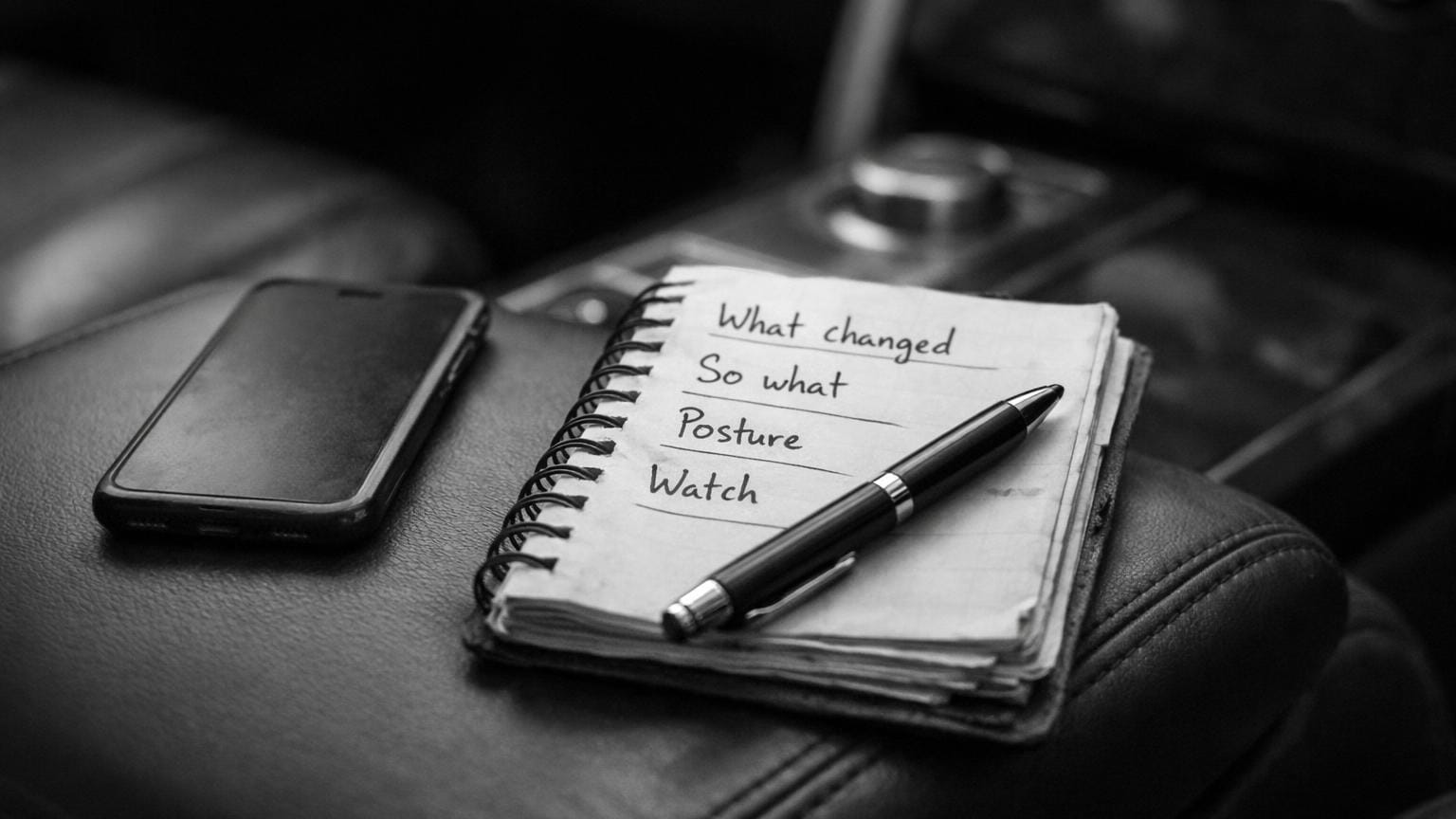
Keep it simple. Every day: a quick scan for what changed. Then another short block to turn that into posture and update the log. Once a week: step back and look for patterns, repeat names, repeat places, repeat grievances, near misses, and whether the sources you watch are still worth your time.
That weekly review is also where you make the adult decision and do some real introspection: do I still control the workload, or is the workload controlling me? If volume consistently exceeds what you can review safely, if language or subculture nuance exceeds your frame, or if leadership starts making strategic decisions based on your informal monitoring, then external monitoring or a dedicated analyst is no longer a luxury. It is risk control. Needing support is not failure. It is a sign the risk profile has outgrown a one-person cell.
Closing
At the end of the day, the smallest discipline is still the most effective: write a brief, even a minimal one. Date. Principal. Location. Key movements. Then a short reflection on what changed, what it means with likelihood and confidence, what posture or actions you took, and what to watch next. If you only fill one part, fill posture and actions. That is where information becomes protection.
The one-person protective cell works when it respects three truths. Overload degrades awareness, so overload is a threat vector. Intelligence is early warning plus translation into posture. Uncertainty is part of the product, and you have to communicate it with discipline.
You cannot react your way out of a compressed moment. The only reliable move is to build a cycle small enough to survive your real day, and clear enough that you can defend it when it matters.
References and further reading
Irwin, D. and Mandel, D.R. (2023) ‘Communicating uncertainty in national security intelligence: Expert and non-expert interpretations of and preferences for verbal and numeric formats’, Risk Analysis, 43(5), pp. 943–957. Available at: publisher page. (Wiley Online Library)
Klein, R.M. and Feltmate, B.B.T. (2025) ‘The vigilance decrement: its first 75 years’, Frontiers in Cognition, 4, 1632885. doi:10.3389/fcogn.2025.1632885. Available at: https://www.frontiersin.org/journals/cognition/articles/10.3389/fcogn.2025.1632885/full
Logan, S. (2024) ‘Tell me what you don’t know: large language models and the pathologies of intelligence analysis’, Australian Journal of International Affairs, 78(2), pp. 220–228. Available at: publisher page. (Tandfonline)
Mackworth, N.H. (1948) ‘The breakdown of vigilance during prolonged visual search’, Quarterly Journal of Experimental Psychology, 1(1), pp. 6–21. doi:10.1080/17470214808416738. Available at: https://www.tandfonline.com/doi/abs/10.1080/17470214808416738 SAGE Journals+1
Maoro, F. and Geierhos, M. (2025) ‘Contestable AI for criminal intelligence analysis: improving decision-making through semantic modeling and human oversight’, Frontiers in Artificial Intelligence, 8, Article 1602998. Available at: journal page. (Frontiers)
Oerlemans, J.J. and Langenhuijzen, S. (2025) ‘Balancing national security and privacy…’, International Journal of Intelligence and CounterIntelligence, 38(2), pp. 579 to 597. https://doi.org/10.1080/08850607.2024.2387850
More sources used in this project are listed in the Resources section.